
- What are Dental Implants?
- How long Will An Implant Last?
- What if I’ve lost too much bone already?
- When do I start losing bone?
- Why is replacing missing teeth so important?
- What Are Mini-implants?
- Implant Replacement or Tooth Supported Bridges?
- Replacing a Partial Denture with Implants
- Implant Retained Dentures (Overdentures)
- Implant Supported Dentures
- Implant Supported Bridges–The Ultimate Replaceement!
- Implant Supported Bridges
Dental Implants
What are Dental Implants?
Back to top
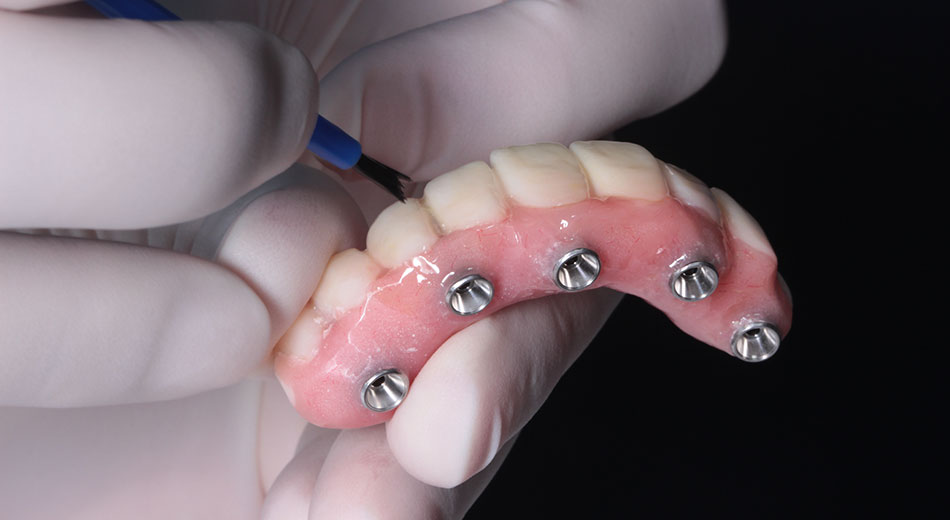
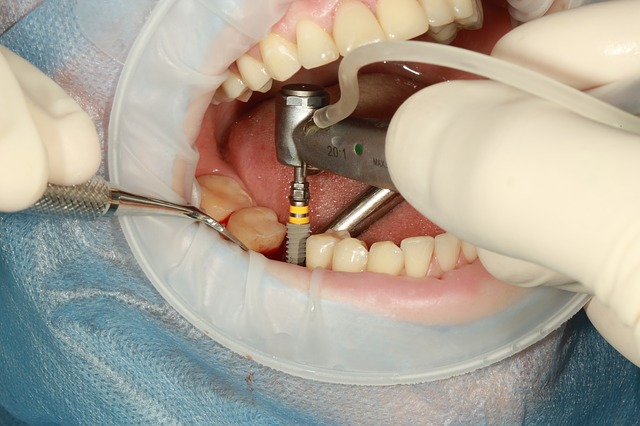
Dental implants are available in several different forms. The most common dental implants are called “root form implants”. Root form implants are similar to teeth in that they mimic the roots of teeth.
The implants are placed in the bone on the first clinical appointment. The dental implants are allowed to heal for a period of three to six months. After this healing time the implants are examined to ascertain their “osteo-integration”, or degree of fusion to the bone. The implant then can be prepared to accept the final prosthetic components.
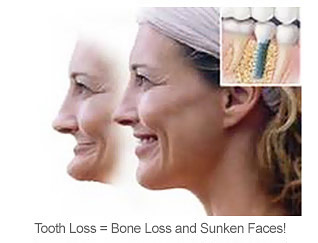
Implants are made of a highly biocompatible material called titanium, which cannot decay and does not need root canal therapy. An advantage of implants is that they stimulate bone growth and thus prevent future bone loss. Bone behaves similar to muscle. When the muscle is stimulated and active, it will grow. If the muscle stops being active, it shrinks. The same events occur with bone, however if bone disappears, it can only be replaced with a bone graft.
In cases where multiple implants need to be placed or in areas where the bone topology is difficult,, advanced technology such as Simplant Planner or Nobel Biocare Nobel-Guide can be used to very accurately place the implants. This software uses CT scans to very accurately visualize the bone in 3-dimensions for accurate implant placement. See our Advanced Technology section for more information!
How long Will An Implant Last?
Back to topModern dental implants have been maintained in individual cases for more than forty years. An implant, although made of metal, still requires continued care after placement. This includes patient home care and professional maintenance. The life of the implant varies with factors of patient health, patient habits (smoking, oral hygiene), and structural overload.
What if I’ve lost too much bone already?
Back to topLuckily, there are many innovative procedures that allow you to grow new bone in your jaw. Bone grafts take bone from one area in your mouth and move it to another. A “sinus lift” can grow more bone to support the top back teeth. Ten years ago we thought this was impossible, but with these new procedures almost anyone can replace their missing teeth with implants.It is important to replace missing teeth as soon as they are lost. This will keep as much healthy bone as possible in the areas where there are no teeth. It’s important not to wait for problems to develop. Untreated, problems will develop. It’s only a matter of time.
When do I start losing bone?
Back to topAs soon as a tooth is lost, either from gum disease or from a surgical procedure, the supporting bone starts to melt aw
ay. This bone is part of your jaw. About 40-60% of the bone is lost from the area where a tooth was extracted within the first two years. Even worse, the remaining bone also become less “dense” and subsequently less able to hold implants.
Why is replacing missing teeth so important?
Back to topReplacement of missing teeth is essential to maintaining the jawbone. That is why a tooth should be replaced very soon after it is lost. Dental implants are man-made replacements for natural teeth. The actual dental implant replaces the root of the missing tooth. It is then used as an anchor to secure the replacement tooth or teeth. Implants allow us to replace missing teeth without harming the healthy natural teeth adjacent to the space. This reduces the future risk of root canals and decay under crowns. Over time, due to lack of use, more of the jawbone disintegrates until it becomes quite difficult to place an implant restoration.
Psychological Significance of Tooth Loss
20% of edentulous (without teeth) patients don’t wear both removable prosthesis all the time.
7% of edentulous patients are not able to wear
their dentures at all
88% of denture wearers have difficulty with
speech
(NIH Oral health of US Adults National Findings Publ. No87 1987
For more information on the health benefits of dental implants, please see Dr. Gibbs’ blog site at http://smileglenellyn.typepad.com/blog/
What Are Mini-implants?
Back to topThe MDI System consists of a miniature titanium implant that acts like the root of your tooth, and a retainer fixture that is incorporated into the base of your denture. Advantages of the mini implants are:![]()
- Placed in as little as one visit
- Low cost: usually about half of traditional implants
- No long healing period
- Secures dentures immediately
Mini-implants can take the anxiety out of waiting for permanent full sized implants to “take hold.” If the implants are being placed to stabilize a denture or to replace a long bridge or partial denture, mini-implants can stabilize replacement teeth to function comfortably and predictably in the interim
Implant Replacement or Tooth Supported Bridges?
Back to topOne decision that many patients have to decide on is whether to replace lost teeth with an implant or bridge. A summary of the advantages and disadvantages are as follows:
| BRIDGE ADVANTAGESCan be completely in about two weeksLook natural and are strong
Can be less expensive (short term!) than implants Can be used to additionally realign misplaced teeth |
BRIDGE DISADVANTAGESBone loss is not stopped in the areas where the teeth are lost-leading to gaps and food getting caught beneath bridgework over timeDifficult to floss beneath requiring special floss or cleaners
If any of the supporting crowns are compromised or get decay around them, the entire bridge needs to be replaced Expected longevity only 5 to 15 years The teeth that will be needed to support the bridge, even if they are in good condition, will need to be drilled away to fit supporting crowns |
| IMPLANT ADVANTAGESPreserves the bone in the areas where the teeth are lostMuch easier to floss and clean around than bridges
Longevity 15 to 40 years Are not susceptible to decay |
IMPLANT DISADVANTAGESInitial cost is usually more expensive than bridgeworkIf the patient waited too long for the implant to be placed additional procedures may need to done to increase the amount of bone for implant support |
In short, most patients find that the implant replacement to more comfortable and easier to care and get less caught around them. The cost of implants is more costly short term, but over a 5 to 20 year period much less expensive and expected longevity is greater. Surrounding teeth are also healthier with implant replacement.
Replacing a Partial Denture with Implants
Back to topMany patient object to having “something removable” in their mouth. Commonly they complain about the feel of all the tooth clasps, food and order getting beneath the partial denture, and ehe look of the clasps when they smile. Here is how we can substitute dental impalnts for a partial denture!
![]() |
![]() |
![]() |
![]() |
| 1. Before the procedure Three teeth at the back end of the mouth are missing. The only real replacement alternative is installing a fixed bridge. The bridge contains all teeth in one piece and is anchored on dental implants. |
2. Installing the implants First, the implants are installed. This is normally done in a single session. Sometimes a temporary bridge can be made soon after the implants are placed. |
3. Attaching the bridge The implants need to integrate with the jawbone before the permanent bridge is attached. This is normally done 3-4 months after the implant installation. The time will vary, depending on the bone quality and esthetic concerns. |
4. End result The new bridge will handle all the pressure that your strong, natural back teeth did. You will have a stable and secure solution that allows you to eat what you want. |
![]() |
Removable partial denture This alternative is often perceived as uncomfortable and a bit complicated to use. Function can’t be compared to that of a bridge. This denture is made of plastic and metal, which affects its look. Partial dentures are less expensive, but may compromise the health of the teeth where they are clasped. |
Implant Retained Dentures (Overdentures)
Back to top
Over many years the bone that used to support and retain dentures erode and the denture can become chronically loose and even fall out randomly. By placing 2 to four implants, we can now “lock-down” the denture. Bone loss is stopped in the area of the implants, but can still continue in the area behind the implants. Most patients say they can now “eat anything” again!
Implant Supported Dentures
Back to topImplant supported overdentures are the next step in comfort over the implant retained dentures. Additional implants are required for the extra support–usally 4 to 5 in the lower jaw and 5 to 6 in the upper jaw. There are several major advantages:
- The bone support is maintained in the back area of the mouth
- The denture is supported entirely by the implant allowing much greater tissue comfort and retention.

- Biting efficiency is now almost like “normal teeth.”
- Preserves your appearance and facial structure.
- Re-newed confidence and quality of life.
Implant Supported Bridges–The Ultimate Replaceement!
Back to topThe Ultimate replacement for dentures that has many benefits including:
- A fixed permanent restoration for individuals who has lost all of their teeth.
- May be an “upgrade from implant retained or support overdentures.
- Lets you eat and function like having natural teeth.
- A solid and stable solution relative to dentures.
- Preserves your facial appearance and prevents bone loss.
- Immediate function in mandible and maxilla.
- Gives a nice natural smile with better esthetics relative to dentures.
- Offers a long-lasting solution, often for life.
- Renewed confidence and improved quality of life as well.
- Are not removable–can not fall out!
- Chewing restored to the level of natural teeth.
- No plastic on the roof of the mouth allowing natural chewing and taste!
![]() |
1:Before the procedureThe dentist determines what needs to be done and prepares both himself and the patient for the coming treatment procedure. |
![]() |
2. Installing the implantsThe first step is installing dental implants to replace the lost tooth roots. The number of implants placed depends on bone condition and the implantologist’s judgement. If conventional implants are done, temporary dentures can be opted to be made or your old dentures may be worn that enable you to eat and function while the implants are left to heal and integrate with the jaw bone. |
![]() |
3. Attaching the bridgeThe final step is the making and securely installing the fixed bridge on top of the implants. |
![]() |
4. End resultYour new teeth should be hard to tell from natural – both for you and others. People who have had traditional dentures before getting a fixed bridge often describe this as an overwhelming and very positive experience. |
For more information and great photographs see the following links:
See our photo gallery for more information on implants and mini-implants. Also, check our patient testimonials for patients feedback. Also check our blog site for more information!
For even more detailed information please either call the office for our FREE special report on “How Your Life Will Change with Dental Implants” or see the Contact page to leave your address or e-mail. Report includes detailed presentation with photos on all implant options, testimonials from happy patients, and a discussion of the benefits that you can achieve!
Implant Supported Bridges
Back to topThe Ultimate replacement for dentures that has many benefits including:![]()
- May be an “upgrade from implant retained or support overdentures.
- Lets you eat and function like having natural teeth.
- A solid and stable solution relative to dentures.
- Preserves your facial appearance and prevents bone loss.
- Immediate function in mandible and maxilla.
- Gives a nice natural smile with better esthetics relative to dentures.
- Offers a long-lasting solution, often for life.
- Renewed confidence and improved quality of life as well.
- Are not removable–can not fall out!
- Chewing restored to the level of natural teeth.

- No plastic on the roof of the mouth allowing natural chewing and taste
![]() |
1:Before the procedureThe dentist determines what needs to be done and prepares both himself and the patient for the coming treatment procedure. |
![]() |
2. Installing the implantsThe first step is installing dental implants to replace the lost tooth roots. The number of implants placed depends on bone condition and the implantologist’s judgement. If conventional implants are done, temporary dentures can be opted to be made or your old dentures may be worn that enable you to eat and function while the implants are left to heal and integrate with the jaw bone. |
![]() |
3. Attaching the bridgeThe final step is the making and securely installing the fixed bridge on top of the implants. |
![]() |
4. End resultYour new teeth should be hard to tell from natural – both for you and others. People who have had traditional dentures before getting a fixed bridge often describe this as an overwhelming and very positive experience. |
For more information and great photographs see the following links:
See our photo gallery for more information on dental implants and mini-implants. Also, check our patient testimonials for patients feedback. Also check our blog site for more information!
Dr. Gibbs has a new blog site dedicated just to dental implants at chicagoimplantdentistry.com and education videos on YouTube at LiveWithoutDentures
For even more detailed information please either call the office for our FREE special report on “How Your Life Will Change with Dental Implants” or see the Contact page to leave your address or e-mail. Report includes detailed presentation with photos on all implant options, testimonials from happy patients, and a discussion of the benefits that you can achieve!